Skip to content
objectif7

Template

TCF Canada writing template

There is no official template: France Éducation international publishes the format, not a structure. Below is a fill-in outline for each of the three tasks, with a word budget for every line that lands inside the limits (Task 1: 60–120 words, Task 2: 120–150, Task 3: 40–60 + 80–120), then the French connectors that hold each text together.

Try a template in the simulator
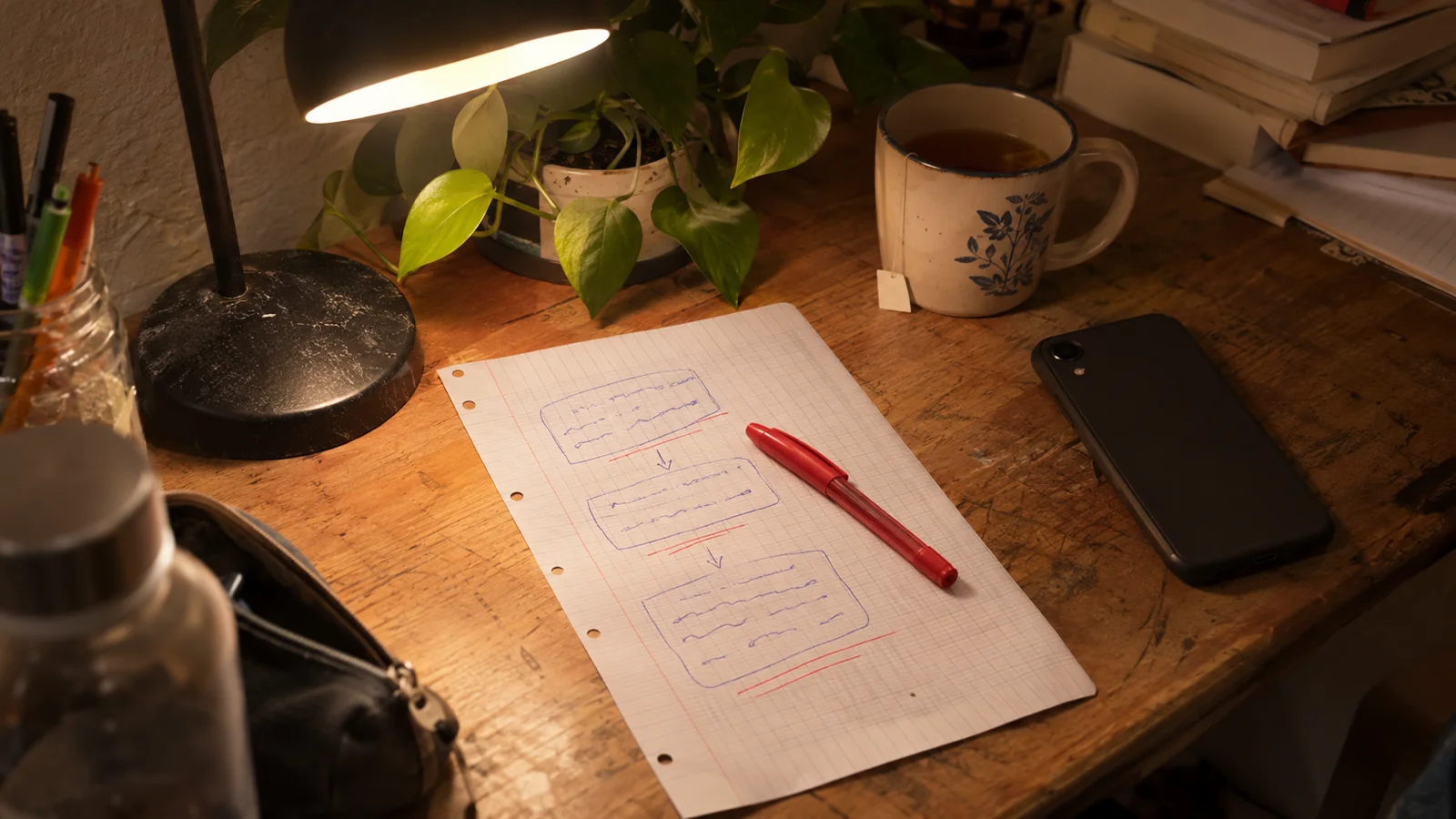
A TCF Canada practice outline on French ruled paper, three boxed blocks linked by arrows, linking words underlined in red pen, a phone timer and a mug of tea
Outline first, then write: two minutes of structure saves ten of rewriting.

The fill-in template for each task

Words in [brackets] are what you replace with the topic's details. The number on each line is a suggested length, not a rule.

Task 1 · Message to one person

About 93 words · limit 60–120 · 15 min

  1. GreetingSalut [prénom], / Bonjour Madame [nom],~3 words
  2. Why you are writingJe t'écris pour te [proposer / raconter / demander]… / Je vous écris au sujet de [objet].~15 words
  3. Point 1D'abord, [première information demandée : quoi, quand, où].~20 words
  4. Point 2Ensuite, [deuxième information], parce que [raison].~20 words
  5. Point 3Enfin, [troisième information ou détail pratique].~20 words
  6. Next stepQu'en penses-tu ? Réponds-moi vite ! / Dans l'attente de votre réponse, je vous remercie par avance.~12 words
  7. Sign-offBises, [prénom] / Cordialement, [prénom nom]~3 words

See a model answer: Report broken heating to your landlord (Task 1)

Task 2 · Article or letter for several readers

About 125 words · limit 120–150 · 20 min

  1. Title[Un titre court qui donne envie de lire]~5 words
  2. ContextLe mois dernier, j'ai [participé à / découvert / essayé] [quoi] à [lieu], avec [qui].~25 words
  3. What happenedAu début, [ce qui se passait, à l'imparfait]. Puis [action, au passé composé]. Ce qui m'a le plus marqué, c'est que [détail].~40 words
  4. Your opinionÀ mon avis, cette expérience [était utile / m'a déçu] parce que [raison]. En revanche, [un point négatif ou une limite].~35 words
  5. Close to the readersJe vous conseille donc de [recommandation]. Et vous, avez-vous déjà [vécu une expérience semblable] ?~20 words

See a model answer: My experience of sharing a flat (Task 2)

Task 3 · Compare two documents, then argue

About 139 words · limit 120–180 · 25 min

Part 1: summary · 40–60 · ~50

  1. The questionLes deux documents traitent de [la question, reformulée].~10 words
  2. Document 1Selon le premier, [idée principale, avec vos mots], car [sa raison].~20 words
  3. Document 2Le second, au contraire, estime que [idée opposée], puisque [sa raison].~20 words

Part 2: your opinion · 80–120 · ~89

  1. Your positionPour ma part, je pense que [votre position].~12 words
  2. Argument 1 + exampleD'abord, [argument]. Par exemple, [fait concret ou expérience].~25 words
  3. Argument 2De plus, [deuxième argument], ce qui [conséquence].~20 words
  4. ConcessionCertes, [l'autre point de vue] ; cependant, [sa limite].~20 words
  5. ConclusionEn somme, [votre position, nuancée].~12 words

See a model answer: Should remote work become the norm? (Task 3)

Connecteurs logiques: the linking words for TCF Canada writing

FunctionConnectorsIn a sentenceTasks
Ordering your pointsd'abord · ensuite · puis · de plus · enfin · pour finirD'abord, la salle est libre samedi. Ensuite, elle est près du métro. Enfin, la location est gratuite.1, 2, 3
Causecar · parce que · puisque · en effet · grâce à · à cause deJe ne pourrai pas venir, car je travaille ce soir-là.« En effet » confirms or explains what you just said; it does not mean « in fact » as a contradiction.1, 2, 3
Consequencedonc · c'est pourquoi · par conséquent · ainsi · si bien queLes loyers augmentent chaque année ; c'est pourquoi beaucoup de jeunes partagent un appartement.2, 3
Contrast and concessionmais · cependant · pourtant · en revanche · au contraire · alors que · bien que (+ subjonctif) · certes… maisCertes, le télétravail fait gagner du temps ; cependant, il isole les nouveaux employés.« Bien que » takes the subjunctive: « bien qu'il soit cher », not « bien qu'il est cher ». In Task 3, prefer « en revanche » to the spoken « par contre ».2, 3
Giving an examplepar exemple · notamment · comme · c'est le cas de · prenons l'exemple deCertaines villes ont réduit le trafic, c'est le cas de Montréal avec ses rues piétonnes l'été.2, 3
Giving your opinionà mon avis · selon moi · pour ma part · je suis convaincu(e) que · il me semble quePour ma part, je suis convaincue que le sport à l'école devrait être quotidien.2, 3
Restating the two documents (Task 3, part 1)selon le premier document · d'après l'auteur · le second soutient que · contrairement au premier · les deux documents s'accordent surSelon le premier document, les écrans nuisent au sommeil des enfants ; le second soutient au contraire qu'ils peuvent aider à apprendre.Restate in your own words: sentences copied from the documents do not show your French.3
Telling a story in time (Task 2)le mois dernier · au début · soudain · au bout d'une heure · finalement · depuisAu début, je ne connaissais personne ; au bout d'une heure, je discutais avec toute la table.2
Concludingen somme · en conclusion · pour conclure · bref · finalementEn somme, interdire les voitures en centre-ville est utile, à condition de renforcer les transports en commun.« Bref » is casual: fine in a Task 1 message or a Task 2 blog post, too light for Task 3.2, 3
words for Task 1, a message to one person, about 15 minutes
60–120
words for Task 2, an article or letter for several readers, about 20 minutes
120–150
words for Task 3: a summary of both documents, then your opinion, about 25 minutes
40–60 + 80–120

Is there an official TCF Canada writing template?

No. France Éducation international (FEI), which writes the TCF, describes each task, its word limits and the skills it checks, and publishes a demo paper. It does not give a model structure. The templates on this page are built from that description: each slot answers one thing the task asks for. Task 1 lists « give the information asked for » and « fit the register to the reader », so the template has a slot per piece of information and a greeting and sign-off in the right register. Task 3 asks you to restate two points of view and then defend your own, so it has two parts with their own word limits.

How to use a template without reciting it

Learn the structure, not the sentences. Examiners rate task fit first: every element the instructions ask for, the right text type, the right register. A paragraph learnt by heart that skips one of the three things the topic asks you to explain loses marks there, however good its French.

Before writing, spend two or three minutes filling the slots with the topic's details in note form. Then write each slot as one or two sentences in your own words. After a few weeks of practice the order of the slots becomes automatic and your time goes into vocabulary and grammar, which are the other criteria.

Word budget: how many words per paragraph

The budgets add up to about 93 words for Task 1, 125 for Task 2, and 50 + 89 for Task 3. That is near the middle of each range, on purpose. A task outside its limits is marked « A1 non atteint », so aim for the middle and check the count at the end, not the edge.

Count the way the exam does: one word is anything between two spaces. « C'est-à-dire » is one word, « un bon sujet » is three, and a question mark standing alone after a space is not a word. The simulator's counter follows that rule.

How many connectors should a TCF text have?

Roughly one connector every two or three sentences, chosen for the link you mean. Coherence is marked on whether the reader can follow your logic, not on how many linking words you use. A wrong connector, « donc » where nothing follows from what came before, costs more than none, and a text that starts every sentence with one reads as a list.

Vary them. A B2 text does not lean on « et » and « mais » alone: one concession (« certes… cependant »), one cause (« puisque »), one consequence (« c'est pourquoi ») already show range.

Timing the 60 minutes

A split that works for most candidates: 15 minutes for Task 1, 20 for Task 2 and 25 for Task 3. In each one, outline for two or three minutes, write, then keep the last two or three minutes to check agreement, accents and the word count. Task 3 needs the most time because you read two documents before you write.

Topics, model answers, timer and word counter are free. Corrections come with a pass.

Open the free writing simulator

Questions about the TCF Canada writing template

Is there an official TCF Canada writing template?

No. France Éducation international publishes the format (three tasks, 60 minutes, word limits) and a demo paper, but no model structure. Templates like this one are practice tools.

Can I use the same template for every topic?

Use the same structure, not the same sentences. Each slot has to carry the details the topic asks for; a memorised paragraph that misses one of them loses marks on task fit.

Should I use tu or vous in Task 1?

Follow the instructions: a friend or a family member gets tu, a landlord, manager or organisation gets vous. Keep the same choice in the greeting, the text and the sign-off.

Which tenses go in Task 2?

Imparfait for the background (« il faisait froid, je ne connaissais personne »), passé composé for the events (« j'ai décidé »), and the present for your opinion and advice.

Is « par contre » wrong in the TCF?

No, it is correct and very common. It sounds more spoken, so in Task 3, the most formal task, « en revanche » or « cependant » reads better.

Sources

  1. France Éducation international: TCF Canada, test format
  2. IRCC: language test equivalency charts

Independent practice tool, not affiliated with France Éducation international or CCI Paris Île-de-France. TCF and TCF Canada are trademarks of France Éducation international, used only to describe the exam. Scores are estimates, not official results.